
Essential Surface Safety Equipment Every Diver Should Carry
Being seen at the surface is just as important as managing your buoyancy underwater. This guide covers every key piece of surface signalling equipment, and why carrying them could save your life.
Every year, divers are injured or killed not from underwater incidents but from surface drifts, carried away from the boat by current after a perfect dive. Boat traffic, poor visibility, and long surface swims are genuine risks in open water. The right surface safety equipment makes you visible, audible, and locatable. None of it is expensive. All of it is worth carrying.
Real-World Diving Scenarios
Understanding how surface safety equipment is used in real situations highlights why it's considered essential.
Drift away from the boat
You surface after a dive and realise the current has carried you further than expected. The boat is nearby, but you're difficult to spot in waves. A surface marker buoy or signal tube makes you visible above the swell.
Boat can't see you
You can see the boat, but they can't see you. Audible signals like whistles or air horns help attract attention quickly, often faster than waving arms.
Low visibility or rough seas
Choppy water and glare make it difficult for crew to distinguish divers from the surrounding water. High-visibility markers and reflective signals improve detection significantly.
Surface at night or low light
You surface in fading light or during a night dive. Strobes or lights become critical for visibility: visible at range even when a DSMB cannot be seen.
Out of visual range
You are too far away for visual or audible signals to be effective. At this point, traditional surface signalling may not be enough, and electronic beacons become the only reliable option.
1. Delayed Surface Marker Buoys (DSMBs)
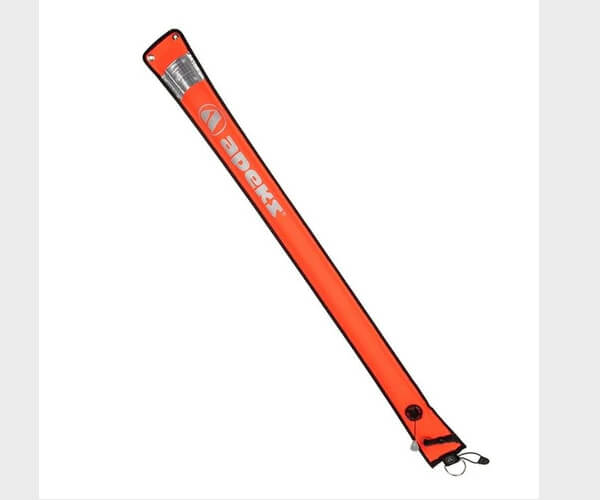
A DSMB (often called a "sausage") is the single most important piece of surface safety kit a recreational diver can carry. Deployed from depth during your safety stop or from the surface if you surface away from the boat, a bright orange or red inflated tube makes you immediately visible.
Choose an open-bottomed DSMB for ease of inflation underwater, or a closed-top version for use only at the surface. A spool with 20-30m of line is enough for most recreational dives. Practice deploying it in a pool before your first open water use: it is a skill that degrades without repetition.
What to look for
- Minimum 1.5m length for visibility in choppy water
- Oral/BC inflator valve (some have both)
- Bright orange or yellow: red can be confused with boat marker buoys
- Retainer ring or clip for your spool/reel
Popular options: Apeks, Halcyon, and Mares all make reliable open-bottomed DSMBs available at most dive shops.
2. Dive Whistles
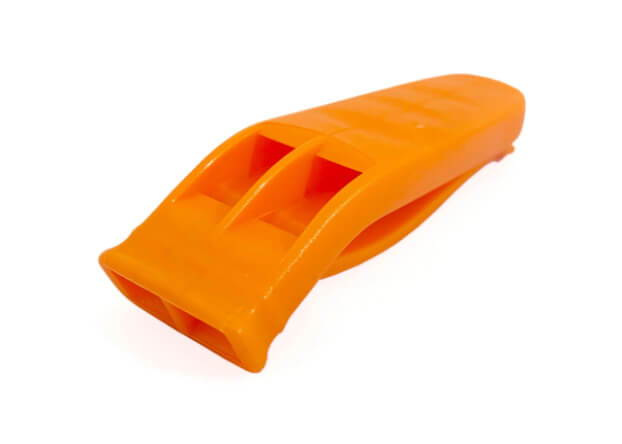
Sound carries further than a waving hand. A dive whistle clipped to your BCD inflator hose or chest D-ring is your fastest way to attract attention at the surface when your DSMB is already deployed and you need to signal the boat crew directly.
Always buy a pealess (no internal ball) model. Standard ball whistles fill with water and stop working entirely when submerged. Pealess designs work wet or dry and can produce 120+ dB at close range, enough to cut through wave noise and outboard engines at 50m.
What to look for
- Pealess design: works completely submerged
- Clip or tab for BCD attachment
- 120+ dB output rating
- Corrosion-resistant polymer body (no metal parts)
3. Surface Strobes and Dive Lights
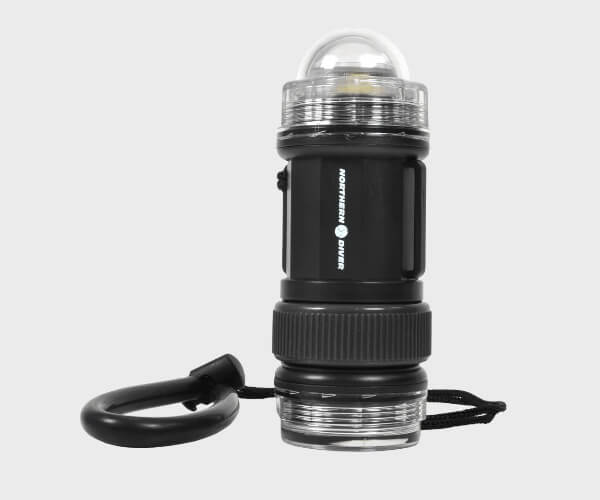
If you dive after dark or in low-visibility conditions, a surface strobe light is non-negotiable. Many recreational divers skip this, treating it as a technical or night-dive-only item, but a strobe is equally effective on an overcast day in choppy water where a DSMB alone may not be spotted quickly.
A dedicated surface strobe clips to your BCD D-ring, runs for hours on a single battery, and flashes at a rate (usually 40-60 flashes per minute) that search-and-rescue teams are trained to identify. Some dive computers now have integrated strobe modes accessible at depth.
What to look for
- Runtime of 8+ hours on a single charge
- Visible at 1+ nautical mile in clear conditions
- Rated to at least 40m depth (so it survives an accidental descent)
- Compact enough to clip to a D-ring without impeding movement
4. Signal Mirrors
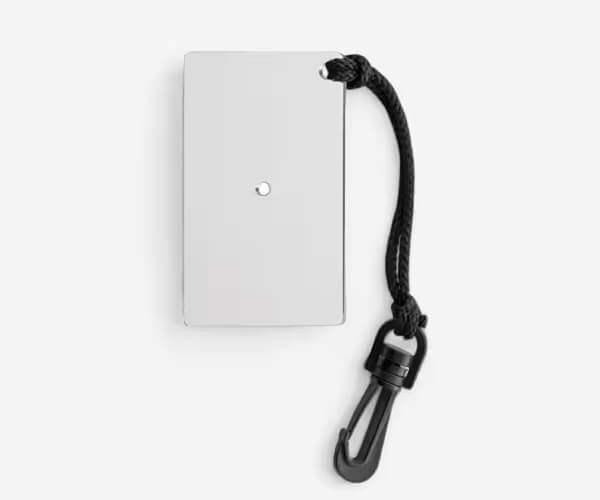
A signal mirror is perhaps the most underrated piece of survival kit a diver can carry. On a bright day, a 5cm × 7cm mirror can reflect sunlight more than 15 miles, far beyond the range of a DSMB or whistle. They weigh almost nothing, have no moving parts, require no batteries, and last a lifetime.
Modern signal mirrors have a retroreflective aiming hole in the centre, making it straightforward to direct the flash toward a vessel or helicopter. Practice before you dive: signalling accurately takes a few minutes to learn but becomes instinctive quickly.
Glass mirrors outperform acrylic in reflectivity but are fragile. Stainless steel or military-spec acrylic strike a good balance of durability and signal strength for dive applications.
5. Personal Locator Beacons (PLBs)
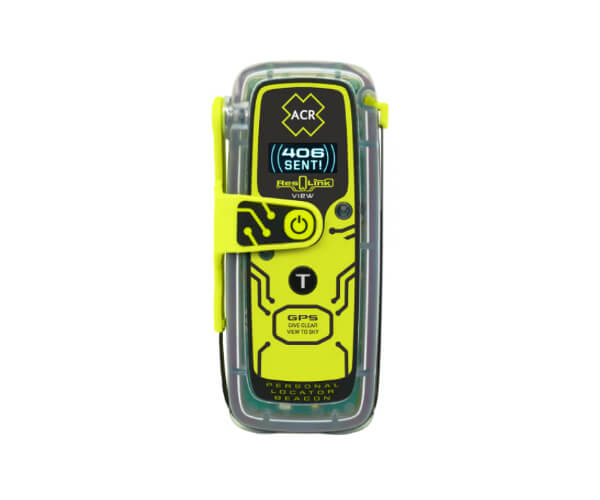
A Personal Locator Beacon (PLB) is the gold standard of maritime emergency signalling. When activated, it transmits on 406 MHz to the Cospas-Sarsat satellite network, an international search-and-rescue system used by coast guards worldwide. Most modern PLBs also transmit a 121.5 MHz homing signal for rescue aircraft and include an integrated GPS module that sends your exact coordinates.
PLBs require registration with your national authority (in the UK: the MCGA; in the US: NOAA). Registration is free and links the beacon serial number to your personal details, dramatically speeding up rescue response.
⚠️ PLB vs EPIRB
An EPIRB (Emergency Position Indicating Radio Beacon) is a vessel-mounted unit designed to float free and activate automatically if the boat sinks. A PLB is worn by an individual and activated manually. For personal dive safety, a PLB is the correct choice.
Recommended: ACR ResQLink 400: compact, waterproof to 15m, 24hr battery, GPS-enabled.
6. Satellite Communicators
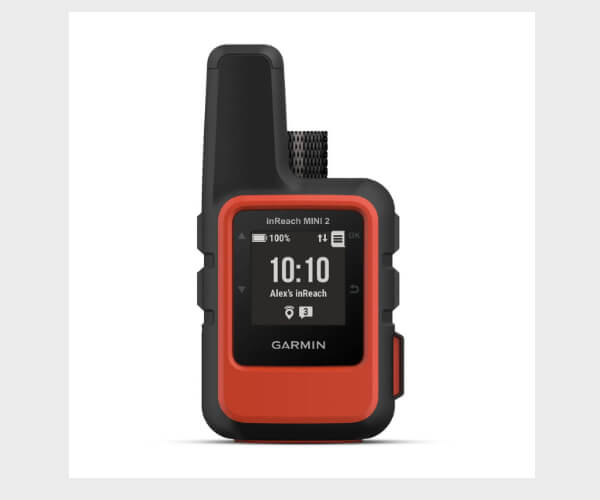
Where a PLB can only send a distress alert, a satellite communicator lets you have a two-way conversation with your boat crew, dive operator, or emergency services, even from the open ocean with no mobile coverage. Devices like the Garmin inReach Mini use the Iridium satellite network and can send GPS coordinates, short messages, and SOS alerts from anywhere on the planet.
Satellite communicators require an active subscription (plans from around £12/month) and are significantly more expensive than PLBs. For liveaboard divers, technical divers, or anyone regularly diving in remote locations without reliable boat-side communication, they represent a significant safety upgrade.
Unlike PLBs, which are single-use emergency devices, satellite communicators can be used proactively: sharing your location with your shore contact, sending check-in messages, and coordinating pick-up from a drift dive.
How Surface Safety Equipment Works
Surface signalling equipment is designed to help divers be seen and heard once they reach the surface.
Visual Signalling Devices
- Surface Marker Buoys (SMBs)
- Delayed SMBs (DSMBs): deployed from depth
- Signal tubes
- Signal mirrors
- Strobes and lights
Audible Signalling Devices
- Pealess dive whistles
- Compressed gas air horns
Most training agencies recommend carrying at least one visual and one audible device on every dive.
What Surface Safety Equipment Should Divers Carry?
Baseline kit: DSMB + pealess whistle. These two items cover the most common surface emergency scenarios and together weigh less than 200g.
Additional equipment for higher-risk diving: Signal mirror (free, zero maintenance), surface strobe (night and low-vis), AIS rescue device (boat diving in busy shipping lanes), PLB (remote locations and extended drift dives).
SMB vs DSMB vs Signal Tube
SMB (Surface Marker Buoy)
Inflated at the surface and held aloft while swimming. Simpler than a DSMB but requires you to be at the surface before deploying.
DSMB (Delayed Surface Marker Buoy)
Can be inflated and deployed from depth, typically during your safety stop. Sends a visible signal to the boat before you surface, allowing them to track your ascent position.
Signal Tube
Inflated at the surface using lung breath. Simpler and cheaper than a DSMB, with no oral valve or spool required. Less visible than a full SMB but better than nothing.
Are Surface Signalling Devices Enough?
When the boat is nearby, visual and audible signals are highly effective. A DSMB is visible for hundreds of metres and a pealess whistle carries 120+ dB across open water.
At range (beyond a few hundred metres, or in fog, or at night) passive signals become unreliable. This is the gap that electronic signalling devices (strobes, AIS, PLBs) are designed to fill. No single device covers all scenarios; a layered approach is always more reliable.
When Is Surface Safety Equipment Most Important?
Drift diving
When the current determines your exit point, there's no certainty about where you'll surface. A DSMB is essential; PLB strongly recommended.
Boat diving
You are dependent on the boat finding you. A DSMB deployed at the safety stop is standard practice; a whistle is a backup for when you need to direct a searching crew.
Reduced visibility conditions
Poor weather, fog, or dusk make visual detection much harder. Strobes and bright-colour DSMBs compensate for the loss of contrast that makes standard buoys hard to spot.
After You're Seen
Surface safety equipment is designed to help others locate you in the water. However, once you've been recovered, responders may still need your identity, medical conditions, allergies, and emergency contacts.
Signalling devices help you get noticed, but they don't provide any information about who you are or how to treat you. Many divers choose to complement their surface safety equipment with an identification system, ensuring that once they are found, they can be assisted quickly and appropriately.
Complete your surface safety with a ScubaID
Surface signalling equipment gets rescuers to you. A ScubaID emergency profile tells them who you are, your blood type, allergies, and who to contact when they arrive. It's the information gap that matters most in a real emergency, and it's free.
Create your free ScubaID →